SEObot: Content Workflow for autonomous blog production for busy founders (2026)
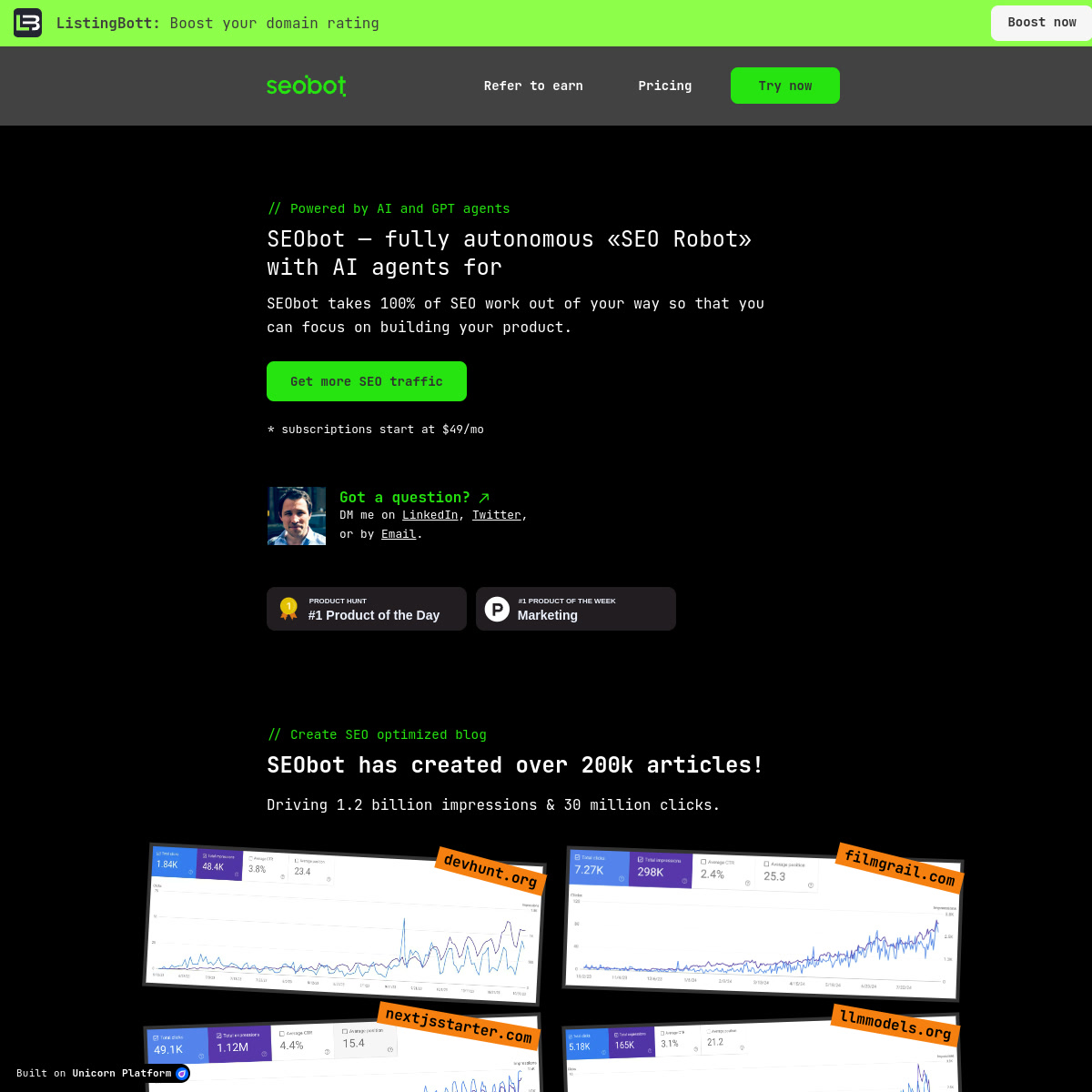
SEObot is a SEO content workflow tool by SEObot built for autonomous blog production for busy founders. It stands out because homepage claims 200,000+ articles created, while also homepage claims 1.2 billion impressions and 30 million clicks generated. Buyers who need content workflow with clear trade-offs will get the most value from it, while teams that want a deeper specialist database should benchmark it against category leaders before committing.
Supports 50+ languages.
This review focuses on workflow fit, pricing clarity, and the practical trade-offs an SEO team should know before rolling the tool into production.
SEObot: Key Specs at a Glance
| Feature | SEObot |
|---|
| Primary use case | Autonomous SEO article production and publishing workflow |
| Best for | Busy founders and lean content teams that want hands-off SEO publishing |
| Access type | Web app |
| Keyword database | Not publicly documented |
| Backlink index | Not publicly documented |
| Data freshness | Not publicly documented |
| Search engines | Google-focused content workflow; other engines are not publicly documented |
| Countries supported | Not publicly documented |
| AI model used | Not publicly documented |
| CMS integrations | Auto sync with popular CMS platforms is publicly claimed; exact list is not publicly documented |
| API availability | Not publicly documented |
| Collaboration / seats | Not publicly documented |
| White label | Not publicly documented |
| Pricing model | Subscription |
| Free plan | No public free plan |
| Paid plans | Starts at $49/mo |
What SEObot Does Well
Autonomous workflow angle
SEObot is positioned as a hands-off SEO publishing system rather than a writing assistant, which makes it more interesting for founders who do not want to manage briefs manually.
Public traction claims
The homepage publishes headline usage claims around article volume, impressions, and clicks, giving buyers at least some scale context before signup.
Language coverage
Support for 50+ languages broadens its appeal for multilingual startups and smaller international brands.
Known Limitations
- Limitation: The site does not publicly document keyword-database sources, SERP data methodology, or how it validates factual accuracy at scale.
- Limitation: Buyers who need strict editorial control may find a fully autonomous workflow harder to govern than a guided optimizer such as Surfer or Clearscope.
- Limitation: API availability, user-seat limits, and integration depth are not clearly documented, which makes technical evaluation slower for larger teams.
- Limitation: The public pricing information is thin beyond the starting price, so cost-at-scale forecasting is weaker than with tools that publish full plan matrices.
Best For: Who Should Use SEObot
- Founder-led SaaS teams that want blog output without building a full in-house content process.
- Lean content teams that care more about workflow automation than granular editorial controls.
- Multilingual teams that want one SEO writing workflow across many languages.
- Startups that need a content engine tied to CMS publishing rather than a pure brief optimizer.
Who Should Look Elsewhere
- Choose a guided content optimizer if editors need transparent scoring, outlines, and sentence-level controls.
- Choose a classic SEO suite if keyword research and backlink analysis matter more than publishing automation.
- Choose a workflow with deeper compliance controls if every article needs legal or expert review before publication.
Pricing & Cost at Scale
Plan Overview
SEObot's homepage exposes only a headline starting price, so it looks simple for small teams but requires more diligence for larger deployments.
- Pricing model: Subscription.
- Free plan / trial: No free plan publicly documented.
- Paid plans: Public homepage pricing starts at $49/mo; broader plan structure is not publicly documented.
Cost at Scale
For a solo founder, the public $49/mo entry point is attractive if the product really replaces multiple manual content steps.
A small agency or multi-brand team should expect hidden scaling questions around seats, publishing volume, and review controls because those limits are not publicly documented.
Enterprise teams should treat SEObot as a workflow experiment first, not a guaranteed full-stack replacement, until governance and cost ceilings are clearer.
Prices are subject to change. Check the official pricing source for current details.
Integrations & Workflow Fit
- The homepage publicly claims auto-sync with popular CMS platforms.
- Specific CMS names and API details are not publicly documented.
- The product is positioned as an end-to-end workflow rather than a standalone keyword research or audit tool.
Getting Started
- Sign up from the homepage and connect your CMS.
- Define the site or product you want to grow and the publishing target.
- Review the first generated content batches before enabling broader automation.
- Track whether the autonomous output is actually moving impressions and clicks in Search Console.
Pro tip: Pilot SEObot on a secondary topic cluster first so you can evaluate quality control, hallucination risk, and publishing cadence before you hand it a core commercial section.
What Users Are Saying
External review signals are still lighter than for mature SEO suites, but the SourceForge and Slashdot footprint suggests buyers are evaluating it as an automation-first SEO publishing product rather than a classic optimization suite.
What users praise: Review-site language emphasizes automation, founder friendliness, and the novelty of outsourcing the full publishing workflow.
Common frustrations: The recurring concern is transparency: buyers want clearer detail about how the workflow works, how much control they keep, and what scaling looks like after the first articles.
Have you tried SEObot? Share your experience in the review section below to help other SEO professionals make the right choice.
FAQ
Is SEObot free?
No. The homepage does not publish a free plan and instead leads with a paid starting price.
How does SEObot compare to Surfer SEO?
SEObot is much more workflow-automation oriented, while Surfer gives editors more explicit optimization controls and content scoring.
Is SEObot good for agencies?
Partially. It can help agencies automate output, but public documentation around seats, approvals, and governance is thinner than agency buyers usually want.
Does SEObot have an API?
Not publicly documented.
Does SEObot support multiple languages?
Yes. The homepage says it supports 50+ languages.
Sources