Keyword Cupid: Keyword Research Tool for SERP-based clustering and topical map creation (2026)
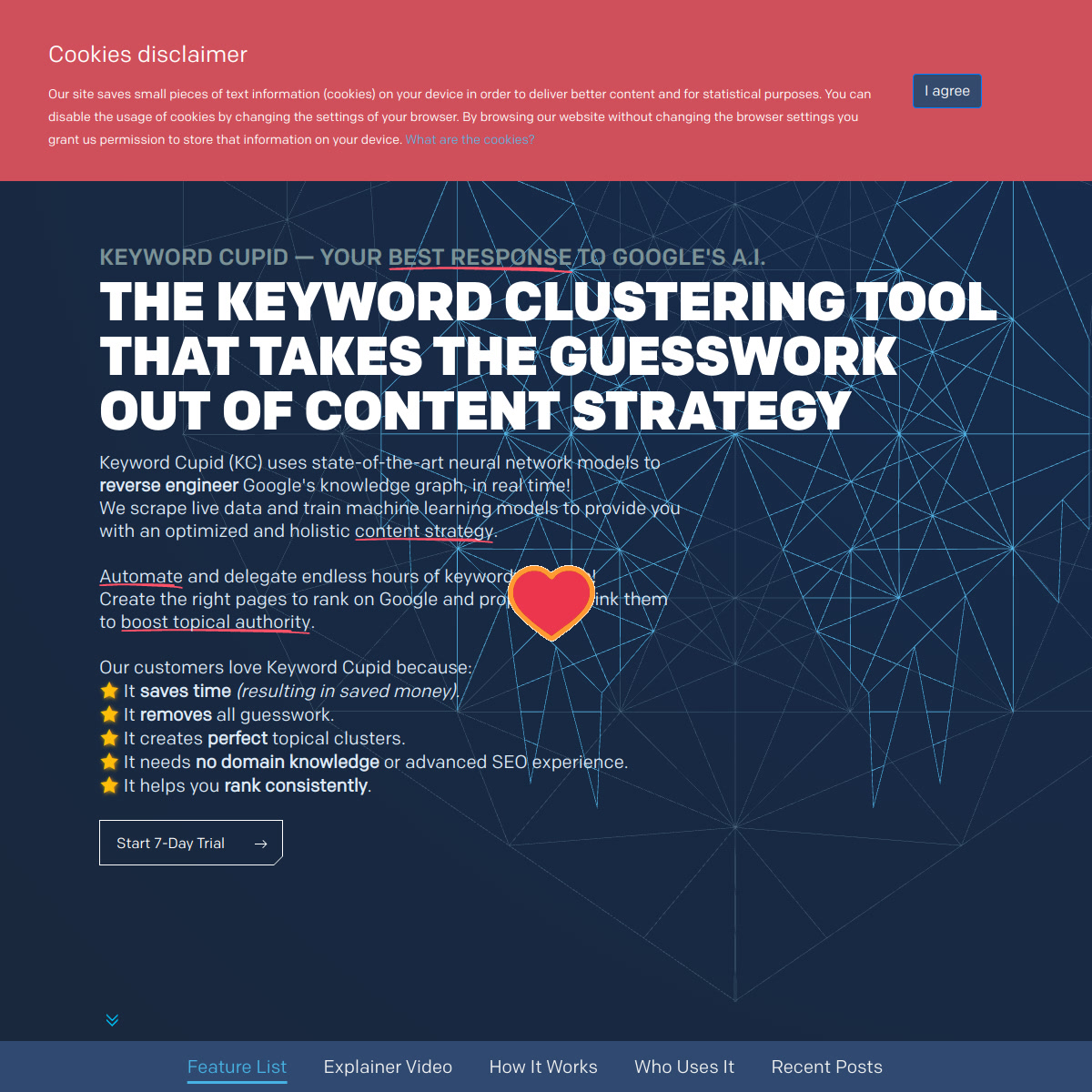
Keyword Cupid is a keyword research tool by Keyword Cupid built for grouping large keyword sets by search intent using live SERP comparisons and turning them into content silos. The core appeal is not generic 'all-in-one' positioning but a workflow that fits SEO consultants, affiliate SEOs, agencies, and topical authority projects. Keyword Cupid’s core differentiator is clustering by ranking-result overlap rather than simple NLP similarity. That makes it more useful when you care about avoiding cannibalization and building page-level topical maps. If your stack depends on a broad backlink database, low-cost casual usage, or a radically different SEO workflow, this is probably not the first tool to evaluate. If you want one platform to handle rank tracking, backlinks, and technical audits too, Keyword Cupid is too narrow.
Keyword Cupid: Key Specs at a Glance
| Feature | Keyword Cupid |
|---|
| Primary use case | grouping large keyword sets by search intent using live SERP comparisons and turning them into content silos |
| Best for | SEO consultants, affiliate SEOs, agencies, and topical authority projects |
| Access type | Web app |
| Keyword database | Live SERP-based reports rather than a published database size |
| Backlink index | Not publicly documented |
| Data freshness | Live SERP analysis per report |
| Search engines | Google-focused with device and search-engine targeting on paid plans |
| Countries supported | SERP geotargeting is included on paid plans |
| SERP features tracked | SERP Spy and URL Analyzer features |
| API availability | Not publicly documented |
| Integrations | Bring Your Own Data reports and export workflows |
| Collaboration / seats | 1 to 20 user accounts depending on plan |
| White label | Not publicly documented |
| Pricing model | Tiered monthly subscription plus extra keyword credits |
| Free plan / trial | No permanent free tier found; official site advertises a 7-day free trial on the highest package |
| Paid plans | Starter $9.99/mo; Freelancer $49.99/mo; Agency $149.99/mo; Enterprise $499.99/mo |
What Keyword Cupid Does Well
SERP-based clustering instead of naive text grouping
Keyword Cupid’s core differentiator is clustering by ranking-result overlap rather than simple NLP similarity. That makes it more useful when you care about avoiding cannibalization and building page-level topical maps.
Visible plan scaling from solo to agency
The official pricing page shows a clean ladder from Starter to Enterprise, with higher keyword limits, more seats, and cheaper overage rates as usage grows.
Workflow goes beyond clustering
SERP Spy, URL Analyzer, content briefs, and downloadable mindmaps mean it is not just a one-click clustering utility. It can feed directly into planning and writing decisions.
Known Limitations
- This is a specialist tool, not an all-in-one suite with backlink, rank tracking, and site audit coverage.
- Heavy users can burn through extra keyword credits quickly if they run large lists often.
- Public documentation does not give the kind of country count or database breadth metrics buyers get from larger suites.
- Teams that need polished stakeholder reporting may still need another layer on top of the raw cluster output.
Best For: Who Should Use Keyword Cupid
- SEOs building topical maps from large keyword exports
- Affiliate and content sites trying to reduce cannibalization
- Agencies organizing research for writers and strategists
- Consultants who want deeper intent grouping than broad suites usually provide
Pricing and Cost Fit
Keyword Cupid uses a tiered monthly subscription plus extra keyword credits. The current public pricing proof is: Starter $9.99/mo; Freelancer $49.99/mo; Agency $149.99/mo; Enterprise $499.99/mo Free-access note: No permanent free tier found; official site advertises a 7-day free trial on the highest package For agencies or larger teams, the main budgeting question is not only the headline subscription price but also how fast usage scales with more sites, more writers, more tracked entities, or more reports. That is why this tool makes the most sense when its core workflow directly replaces manual SEO labor you are already paying for.
Workflow Fit
In day-to-day SEO work, Keyword Cupid fits best when the team knows exactly what job it is hiring the product to do. It is strongest when used for SERP-based clustering and topical map creation, and weaker when forced to act like a universal replacement for every other tool in the stack. The public product pages support that reading: they emphasize grouping large keyword sets by search intent using live SERP comparisons and turning them into content silos rather than a broad, catch-all promise. If your workflow already depends on another suite for backlinks, deep technical diagnostics, or executive reporting, think of this product as a specialist layer unless your evaluation proves otherwise.
What Users Are Saying
External proof used before listing creation:
Across the external coverage above, the recurring theme is that buyers value the workflow fit when they need this exact job done, but they also compare it against more general SEO platforms when budget pressure increases.
When Not to Choose Keyword Cupid
If you want one platform to handle rank tracking, backlinks, and technical audits too, Keyword Cupid is too narrow.
Teams should also validate how well SERP-based clusters translate into real editorial decisions after export. A clustering tool can look impressive in demo mode but still create too many edge cases once writers, editors, and strategists start using the outputs in production. The best fit is usually an SEO team that already works from briefs and topical maps, not one that expects clustering alone to solve content strategy.
Final Verdict
Keyword Cupid is a strong fit for SEO consultants, affiliate SEOs, agencies, and topical authority projects when the buying decision is centered on SERP-based clustering and topical map creation. The public proof is good enough to confirm positioning, feature intent, and pricing model, but several hard benchmarking metrics remain live serp-based reports rather than a published database size or serp geotargeting is included on paid plans. That means it is best evaluated through a live trial or pilot against your actual SEO workflow, not just by comparing marketing pages.
FAQ
Does Keyword Cupid have a free plan?
No permanent free plan is clearly documented, but the official page advertises a 7-day free trial.
What does Keyword Cupid do best?
It is strongest at SERP-based keyword clustering and turning large lists into page-level topical structures.
Is pricing simple?
Mostly. The base plans are clear, but large-volume users also need to budget for extra credit purchases.