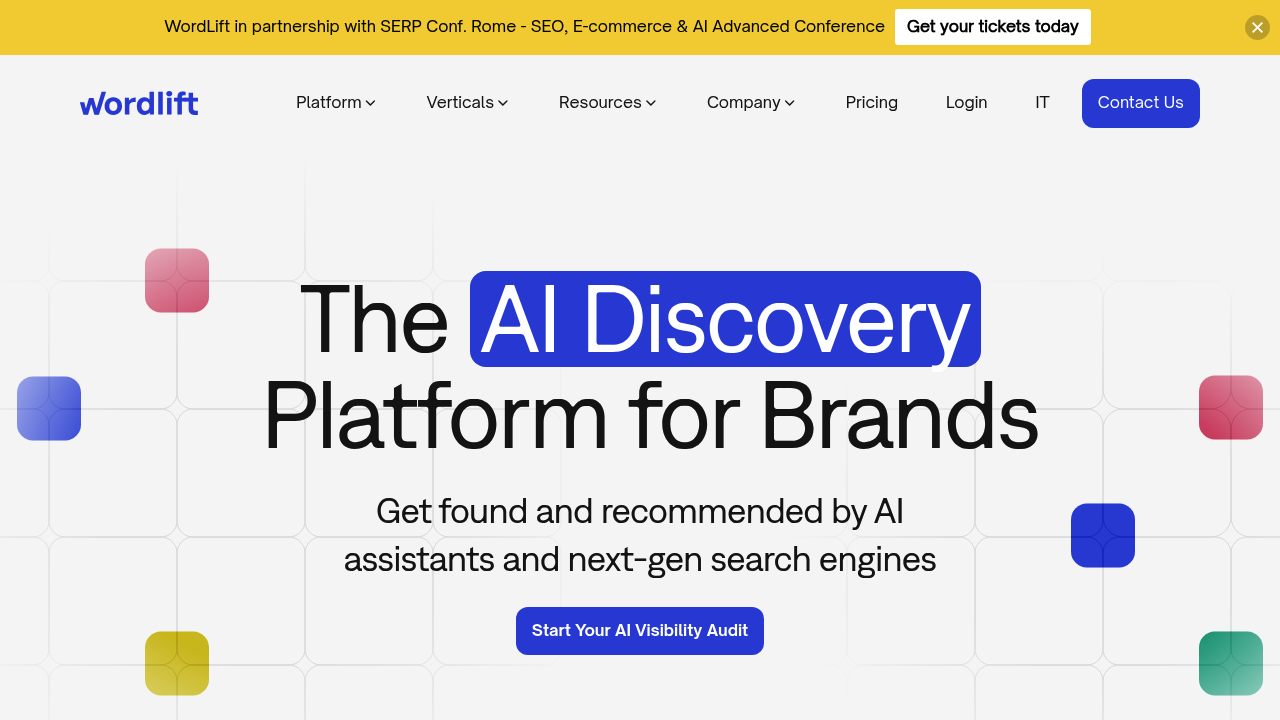
WordLift: AI-Powered SEO and Knowledge Graph Platform for Enterprise Websites (2026)
WordLift is an AI-powered SEO platform by WordLift S.r.l. that builds structured data and knowledge graphs at scale, helping enterprise websites communicate their content to search engines and AI systems through automated schema markup generation. Unlike general SEO tools, WordLift specializes in entity-based SEO and structured data — areas increasingly critical as both traditional search and generative AI rely on semantic understanding to rank and cite content.
WordLift targets enterprise content teams, e-commerce operators, and SEO agencies managing complex websites that need to improve how search engines and AI models interpret their content entities (products, articles, people, organizations, locations).
Teams looking for a standard keyword research, rank tracking, or backlink analysis tool should look at Semrush, Ahrefs, or SE Ranking instead. WordLift is a complementary technical SEO layer, not an all-in-one SEO suite.
WordLift: Key Specs at a Glance
| Feature | WordLift |
|---|
| Primary use case | Schema markup automation, knowledge graph building, structured data at scale |
| Best for | Enterprise SEO teams, e-commerce, media publishers, and agencies managing content-heavy sites |
| Access type | Web platform (SaaS) + WordPress plugin + open API |
| Keyword database | Not applicable (not a keyword research tool) |
| Structured data types | Article, Product, FAQ, How-To, LocalBusiness, Recipe, Event, and custom entity types |
| AI features | AI content generation (product descriptions, Q&A pairs, internal linking suggestions) |
| Data freshness | Real-time schema deployment; knowledge graph updates on content publish |
| Search engines | Google (primary), Bing, and generative AI engines (ChatGPT, Gemini, Perplexity) |
| Countries supported | Global; 54+ languages supported |
| API availability | Yes — open API for custom knowledge graph integrations |
| Integrations | WordPress, WooCommerce, Shopify (via API), Google Search Console, Google Analytics |
| Collaboration / seats | Multi-user; team access based on plan |
| White label | Available for agency plans |
| Pricing model | Subscription + credit-based AI usage |
| Free plan | No (free tools available on website) |
| Paid plans | Business+ from €799/month (billed yearly) or €999/month (monthly); Enterprise custom |
What WordLift Does Well
Automated Schema Markup at Scale
WordLift's core strength is generating and maintaining schema markup across thousands of URLs without manual coding. The platform analyzes page content, identifies entities, and deploys structured data automatically — reducing the time and technical skill required to implement comprehensive schema coverage compared to manual approaches using Google's Structured Data Markup Helper or JSON-LD coding.
Knowledge Graph Construction for AI Search
WordLift builds an interconnected knowledge graph of your content's entities, creating a data layer that AI systems and search engines use to understand relationships between people, products, locations, and concepts. A 2026 client case study showed impressions up 181% in three months after WordLift deployment, driven by improved entity recognition in AI search and featured snippets.
AI-Powered Content Enrichment
WordLift's credit-based AI tools generate Q&A pairs (25 pairs per credit), short product descriptions (20 per credit), and internal linking suggestions (60 per credit) — directly feeding structured data while accelerating content workflows. This makes WordLift particularly effective for e-commerce teams managing large product catalogs that need both human-readable descriptions and machine-readable structured data.
Known Limitations
- High price point: Business+ at €799/month (billed annually) targets enterprise budgets. Small teams or individual SEOs cannot justify the cost compared to simpler schema plugins like Schema Pro ($69/year) or Rank Math's built-in schema features.
- Not an all-in-one SEO suite: WordLift does not provide keyword research, backlink analysis, rank tracking, or site auditing. It requires a separate primary SEO platform, increasing total stack cost.
- Credit expiration: Monthly AI credits expire at month end; annual subscription credits expire at year end. Unused credits do not roll over, which can lead to wasteful usage patterns for teams with seasonal publishing cycles.
- Learning curve for non-technical users: While WordLift abstracts much of the technical complexity, understanding knowledge graphs, entity disambiguation, and schema types still requires SEO knowledge that content writers may lack without training.
Best For: Who Should Use WordLift
- Enterprise e-commerce teams managing 1,000+ product pages who need automated schema markup for rich results (reviews, prices, availability)
- Media publishers and news organizations seeking Google News article schema, FAQ rich results, and entity-based authority signals
- Enterprise SEO teams building GEO strategies who need AI systems to accurately understand and cite their brand's content entities
- Agencies managing multiple enterprise clients who need scalable structured data implementation without per-site manual coding
Who Should Look Elsewhere
- Small business owners managing single websites: Rank Math (free) or Schema Pro ($69/year) cover essential schema markup at a fraction of the cost.
- Teams needing comprehensive SEO capabilities: If you need keyword research, rank tracking, and backlinks alongside schema, Semrush or Ahrefs with manual schema implementation is more cost-effective.
- Developers who prefer code control: WordLift's automated approach may conflict with custom JSON-LD implementations on highly technical sites where precise schema control matters more than automation speed.
Pricing & Cost at Scale
Business+ Plan: €799/month (billed yearly) or €999/month (monthly). Includes WordLift Agent, Knowledge Graph, AI-Powered Content Creation, Content Optimization & Audits, Performance & Rank Tracking, and Schema Markup tools. Covers 2,500 URLs and 5KG total usage with monthly Smart Credits.
Enterprise Plan: Custom pricing. Includes everything in Business+, plus bespoke knowledge graph development, custom AI solutions, full API access, dedicated onboarding, and senior strategist support.
Solo SEO consultant: Not practical — Business+ starts at nearly $10,000/year, far exceeding freelancer budgets for a specialized structured data tool.
Agency with enterprise clients: Business+ or Enterprise plans are appropriate. ROI depends on the number of client sites and the volume of schema implementation work that WordLift automates.
Prices are in EUR and subject to change. Check wordlift.io/pricing for current plans.
Integrations & Workflow Fit
- Key integrations: WordPress (native plugin), WooCommerce (product schema), Google Search Console, Google Analytics, custom CMS via API
- API: Open API enables custom knowledge graph integrations and programmatic schema deployment for non-WordPress platforms
- Workflow fit: WordLift fits as a technical SEO layer complementing your primary SEO platform. It's not a standalone tool — expect to use it alongside Semrush or Ahrefs for keyword and backlink work.
Getting Started
- Visit wordlift.io and request a demo or start with the Business+ plan
- Install the WordLift WordPress plugin or integrate via API for non-WordPress sites
- Run an initial content analysis to let WordLift identify entities across your existing pages
- Review the Knowledge Graph to verify entity disambiguation before publishing structured data
Pro tip: Start with your highest-traffic product or article pages to measure structured data impact on rich result eligibility in Google Search Console before scaling across the full site.
What Users Are Saying
Enterprise SEO practitioners and content teams report measurable improvements in organic visibility and AI search citations after WordLift implementation, particularly for e-commerce product pages and media publishers.
What users praise: The ability to build a semantic data layer without coding, measurable impact on featured snippets and rich results, and responsive support from the WordLift team.
Common frustrations: High price point for the Business+ tier, credit expiration model that penalizes seasonal publishing, and the need to use a separate primary SEO platform alongside WordLift.
Have you tried WordLift? Share your experience in the review section below to help other SEO professionals make the right choice.
FAQ
Is WordLift free?
No. WordLift offers free SEO tools on its website (Product Knowledge Graph Builder, etc.) but the full platform requires a paid subscription starting at €799/month (Business+ plan, billed annually). There is no free tier of the main platform.
How does WordLift compare to Rank Math for schema?
Rank Math offers built-in schema markup as part of its free or Pro ($6.99/month) WordPress SEO plugin — practical for sites needing standard schema types without enterprise scale. WordLift's Business+ plan at €799/month is designed for enterprise knowledge graph construction, AI content enrichment at scale, and structured data across thousands of URLs with advanced entity disambiguation that Rank Math does not provide.
Is WordLift good for agencies?
Yes, for agencies with enterprise clients. WordLift's agency-level plans include white label capabilities and scalable implementation across multiple client sites. For agencies serving SMB clients, the cost is generally prohibitive.
Does WordLift have an API?
Yes. WordLift provides an open API enabling custom knowledge graph integrations, programmatic structured data deployment, and connection to non-WordPress CMS platforms. API documentation is available in the WordLift developer resources.
Does WordLift help with AI search (GEO)?
Yes. WordLift's knowledge graph and entity-based structured data directly improve how generative AI systems (ChatGPT, Gemini, Perplexity) understand and cite your brand's content. One client reported 181% growth in impressions in three months, partly attributable to improved AI search visibility.
Sources