First Answer: Trend Tracking Tool for AI Search Visibility and Answer-Engine Monitoring (2026)
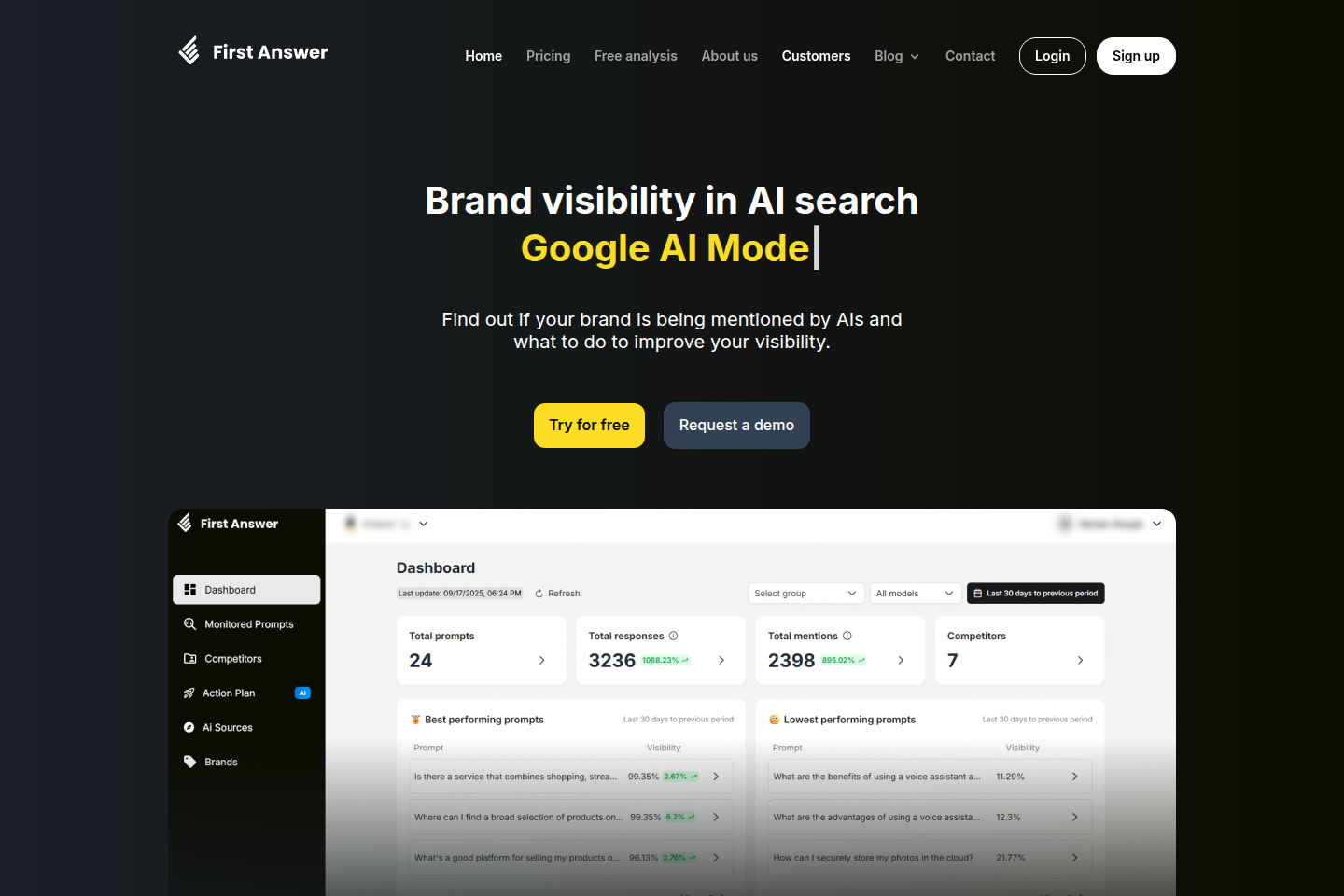
First Answer is an AI-search visibility platform built around a simple question: when buyers ask AI systems for recommendations, does your brand appear, and how often do competitors win the answer instead? The platform focuses on prompt monitoring, mention frequency, visibility position, cited sources, and action planning across ChatGPT, Google AI, Gemini, Perplexity, Grok, and Bing Copilot. That makes it a reasonable fit for brands treating AI answers as a new discovery channel and wanting a trend-focused reporting layer. It is less compelling for teams that still need broad traditional SEO tooling first, because the product is clearly optimized around answer-engine visibility rather than classic keyword and link operations.
First Answer: Key Specs at a Glance
| Feature | Details |
|---|
| Primary use case | Track how brands appear across AI-generated answers, prompts, citations, and competitors. |
| Best for | Brands that want ongoing AI-visibility trend monitoring and answer-engine optimization guidance. |
| Access type | Web platform with public pricing and free analysis hooks. |
| Keyword database | Prompt and AI-search tracking are core, but a classic keyword database size is not publicly documented. |
| Backlink index | Not publicly documented. |
| Data freshness | Monitoring frequencies vary by plan; exact public SLA is not fully documented. |
| Search engines | ChatGPT, Google AI, Gemini, Bing Copilot, Grok, and Perplexity are explicitly referenced. |
| Countries supported | Not publicly documented. |
| SERP features tracked | AI mentions, citations, average visibility position, competitor comparison, and prompt analysis. |
| API availability | Not publicly documented. |
| Integrations | Not fully documented publicly. |
| Collaboration / seats | Not publicly documented. |
| White label | Not publicly documented. |
| Pricing model | Monthly no-commitment plans. |
| Free plan | No permanent free plan is documented, but free analysis is publicly offered. |
| Paid plans | Monthly plans are public; the platform advertises no-commitment monitoring tiers. |
What First Answer Does Well
The product speaks directly to the AI-discovery problem
First Answer does not try to be a generic SEO dashboard. Its messaging stays centered on answer engines, monitored prompts, citation frequency, average visibility, and competitor comparisons, which makes the use case easy to understand for brands already seeing AI search as a live channel.
The positioning is strategic, not just tactical
The homepage repeatedly frames AI as a new point of contact with buyers, then backs that up with prompt analysis and tailored action plans. That is useful for teams that need leadership buy-in for AI visibility work, not just a low-level monitoring widget.
The public pricing and no-commitment framing help evaluation
Unlike many AI-visibility tools that force a sales call, First Answer advertises public monthly plans and emphasizes no-commitment monitoring tiers. That lowers friction for mid-market teams that want to test the workflow before turning it into a bigger program.
Trend analysis is built into the value story
Average visibility position, citation frequency, and monitored prompts make First Answer feel better suited to recurring reporting than to one-off checks. That supports the category fit as a trend-tracking tool rather than a generic GEO label.
Known Limitations
- The public site is clearer on the product story than on deep integration or developer detail, which may limit confidence for technical teams.
- Classic SEO capabilities like backlink intelligence, technical crawling, and large-scale keyword discovery are not the product's focus.
- Many plan and seat details remain lighter than buyers may want compared with more mature SEO software categories.
- If a team has not yet defined who owns AI-search reporting, the platform can become another strategic dashboard without clear operational follow-through.
- Because the category itself is moving quickly, buyers should validate whether their monitored prompts actually map to revenue-sensitive discovery moments before scaling usage.
Best For: Who Should Use First Answer
- Brands that want recurring AI-visibility reporting and competitor comparison rather than occasional checks.
- Marketing teams trying to understand whether answer engines are already affecting discovery in their niche.
- Organizations looking for a trend-focused AEO/GEO layer with public pricing and lower evaluation friction.
- Teams that already have traditional SEO tooling and now need AI-answer monitoring on top.
Who Should Look Elsewhere
- SEOs who still need a foundational suite for backlinks, crawling, and keyword expansion before adding an AI layer.
- Technical buyers who require richer public API and integration documentation up front.
- Small teams without the bandwidth to convert visibility reports into page, source, or content changes.
Pricing & Cost at Scale
First Answer positions itself around monthly, no-commitment monitoring plans rather than demo-only procurement. That is commercially useful because teams can evaluate the reporting layer without immediately entering an enterprise sales process.
The practical cost question is less about the absolute price and more about the workflow behind it. If the team is only curious about AI search, even a modest monthly plan can become shelfware. If prompts, citations, and competitor answers already matter, the pricing becomes easier to justify.
The strongest commercial case is for brands that already believe AI answers influence category discovery and need recurring trend reporting, not for teams still trying to decide whether the channel matters at all.
Workflow Fit
First Answer fits best as a recurring trend and competitive-monitoring layer. It helps brands see how frequently they appear, where competitors overtake them, and which prompts or cited pages influence that result across major AI engines.
That makes it useful for quarterly or monthly visibility reviews, especially when teams want to measure the impact of better source pages, clearer answer-first formatting, or updated comparison content over time.
Getting Started
- Start with the free analysis flow to confirm the platform surfaces relevant prompts for your niche.
- Choose a small prompt set tied to real buyer questions before expanding coverage.
- Track direct competitors from the first reporting cycle so your visibility trend has context.
- Use the output to prioritize pages or sources most likely to influence citations.
- Review whether the product is being used for actual content decisions before expanding the monitoring scope.
What Users Are Saying
First Answer's external proof in this run comes from third-party product explainers and comparison pages rather than heavyweight review portals. That still matches the maturity of the category: buyers are researching what these tools do and how they compare before the review ecosystem fully stabilizes.
FAQ
What does First Answer monitor?
It monitors AI-search visibility, prompt performance, citations, competitor presence, and brand position across major answer engines.
Is First Answer a full SEO suite?
No. It is best treated as an AI-visibility and trend-monitoring layer rather than a classic all-in-one SEO platform.
Does First Answer offer a free plan?
A permanent free plan is not clearly documented, but the site does offer free analysis entry points.
Who gets the most value from First Answer?
Brands already treating AI answers as a meaningful discovery channel and wanting recurring trend reporting.
Sources